Pages

Sunday, 17 July 2022

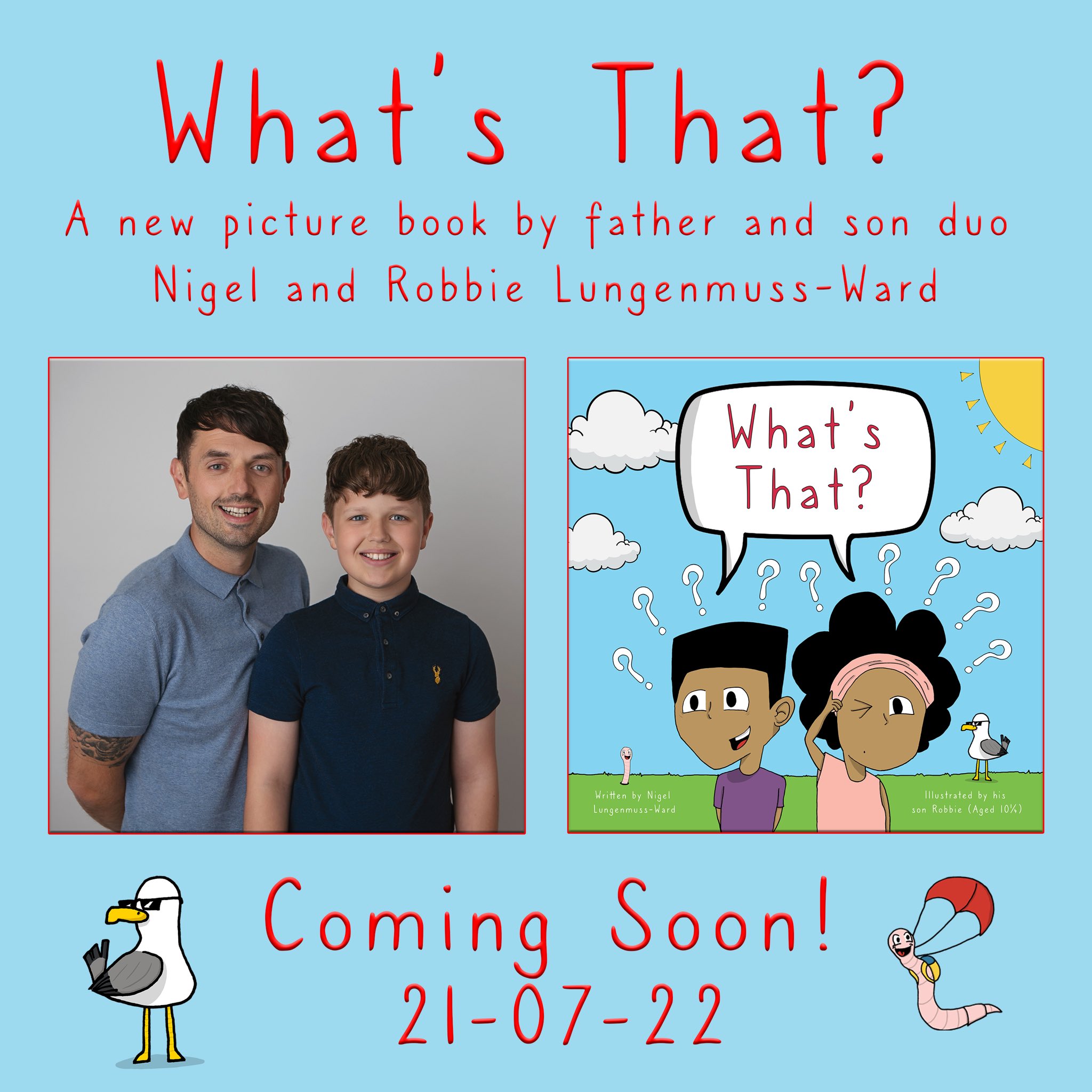
What's That? by Nigel and Freddie Lungenmuss-Ward

Last week, the pupils at Moorlands Primary Academy were fortunate enough to receive an advance copy of What's That?, the new book by Nigel Lungenmuss-Ward and his son, Robbie. I was also able to catch up with Nigel and ask him a few questions about the book.

What's That? was a real hit with the children. Below is a selection of the feedback from our Year One and Two pupils and staff.

"I love the seagull and worm." Harlee
"I enjoyed this story because she was using her imagination." Stanley
"It was amazing because I loved all the things that the children thought the cloth could be." Charlie
"This book is really creative and I like the drawings." Nellie
"I loved the colourful pictures in the book. It's really funny because there's a funny worm" Ella
"I loved it, loved it, loved it because the pictures were funny." Eloise
"I liked the giant in the story because it was the same one from Jack and the Beanstalk." Sam
"It's a great story because it's colourful and funny." Hollie
“My favourite part was when dad was reading Freddie's Impossible Dream!" Jessica
"I like that they use their imagination." Ollie
"I thought it was very funny and imaginative." Emmy
"The cloth can be anything they want it to be." Mary-Jane
"This book is very funny and I just loved the seagull." Hugo
"I loved the way that the story encouraged the children to use their imaginations to enter a fantasy land and explore endless possibilities." Miss Thurtle

Hi Nigel, I was a huge fan of your debut book, Freddie's Impossible Dream. Your new book, What's That?, all about the power of imagination, is out now. Where did the original idea come from?

Thanks Jon. I really appreciate your support and guidance with the promo for the first book. The inspiration for this book came from a game I invented, which I played my class during transition week each year. After reading some research on developing divergent thinking within the workplace I created The Imagination Game to promote divergent thinking within my classroom. I would find a warm sunny spot on the playground and present the class with a random object. Once, I used my lunch box and, after a brief introduction on convergent and divergent thinking, I asked them, “What’s this?” The first couple of children would usually stare blankly at me until someone raised the bar. One child described my lunch box, whilst giving a physical demonstration, as a potty. After this, the divergent thinking would rapidly become more fantastical. I loved this activity as it offered me a gateway into each child’s mind and, more importantly...it was also extremely fun!

How do you suggest teachers encourage children to use their imaginations at school?

I learned a very important lesson whilst working with Robbie during the completion of our first book, which I feel made me a better father and educator alike. It happened right at the very start of Robbie drawing the pictures. I used to give him lots of details on how I imagined the page would look. I would draw stick men and lay the page out for him. I thought I was helping him, but I found that I was actually killing his creativity and passion for the project. His drawings were not as good as the ones he was completing when he was just doodling and doing it for fun. In fact, he stopped wanting to even work on the book altogether. So, I tried a different approach. I gave him minimal guidance and just wrote down the words for each page and asked him to draw whatever he thought matched my narrative. I found this is when his drawings really improved and his passion for the project returned. The lesson I took into my classroom was to try and not over scaffold things. Educators can sometimes be so engrossed in making sure that a child achieves an outcome that we remove any form of creativity and independence for the child. Of course, we need to support but from that day on I tried to pare it back whenever I could.

It's lovely to see that you've continued to work with your son as the illustrator. Did the text lead the artwork or did the artwork lead the text? What was the creative process behind the book?

As I mentioned in the previous question, I write the story and then approach Robbie with it for him to draw. With What’s That? though I asked him to start drawing the main characters before I had finished my final draft. This is the part I think he enjoys the most. He loves creating new characters and that is why I gave him free rein with Wormington and Siago in this story, just like I did with Crabbie in Freddie’s Impossible dream. These characters are all Robbie’s work. I have very little input at all. In fact, I asked him for a character and of course he decided we were having two. Whenever I visit schools with Freddie the children love the Crabbie character the most and I really enjoy telling them that an 8-year-old boy created it. I have a feeling that it will be the same again with Wormington and Siago, which really is magical.

We were very lucky to have you visit Moorlands at the start of the year. I believe it was one of your first school visits and our children still mention you regularly. What do you think an author visit can add to a child's school experience?

It was a pleasure to visit your school and meet all of your wonderful readers! It is so great to hear that the children remember me and that they enjoyed my visit. I have checked this; Moorlands was my very first in school author visit. I was keen to come to your Moorlands as I know the culture of reading for pleasure that exists in the school. From my experience of visiting schools, the main benefit of having an author visit is the impact it can have on a child’s view of reading and writing. I always try to make my visits fun, engaging and inspirational. I particularly enjoy it when I tell children I love reading and writing and they respond in kind. I feel that having someone, who isn’t the children’s teacher, deliver this message is vital to changing some children’s outlook upon the subjects. I have had several instances where teachers have got in touch to explain how students have changed post visit and they have become much more open to reading books or even a bigger variety of books. If I can play a small part in changing even one child’s life for the better then I will be a very happy man indeed.

What's next for you and Robbie?

We keep creating. My vision is to release a book every year, which will serve as a timeline of Robbie’s drawing development. I believe that the illustrations for What’s That? are a vast improvement on the illustrations in Freddie’s Impossible Dream. I write because I enjoy it, but really, I write because I want to showcase Robbie’s talent and give him the best possible platform to achieve whatever he wants in life. As an educator, I feel that the journey Robbie and I are on has the potential to inspire others to go and chase their dreams and to achieve whatever they want too. I have several other ideas and first drafts that are waiting to be published. I am also really looking forward to working for the National Literacy Trust over the summer. I will be leading six writing workshops for children with the aim of creating three stories based on inventions from our hometown of Lowestoft, which will be showcased later in the year. I am so excited about what the future holds, and I cannot wait to hear what people think of What’s That?

Fantastic Nigel, thank you for your time. Good luck with the book launch!
Friday, 8 April 2022

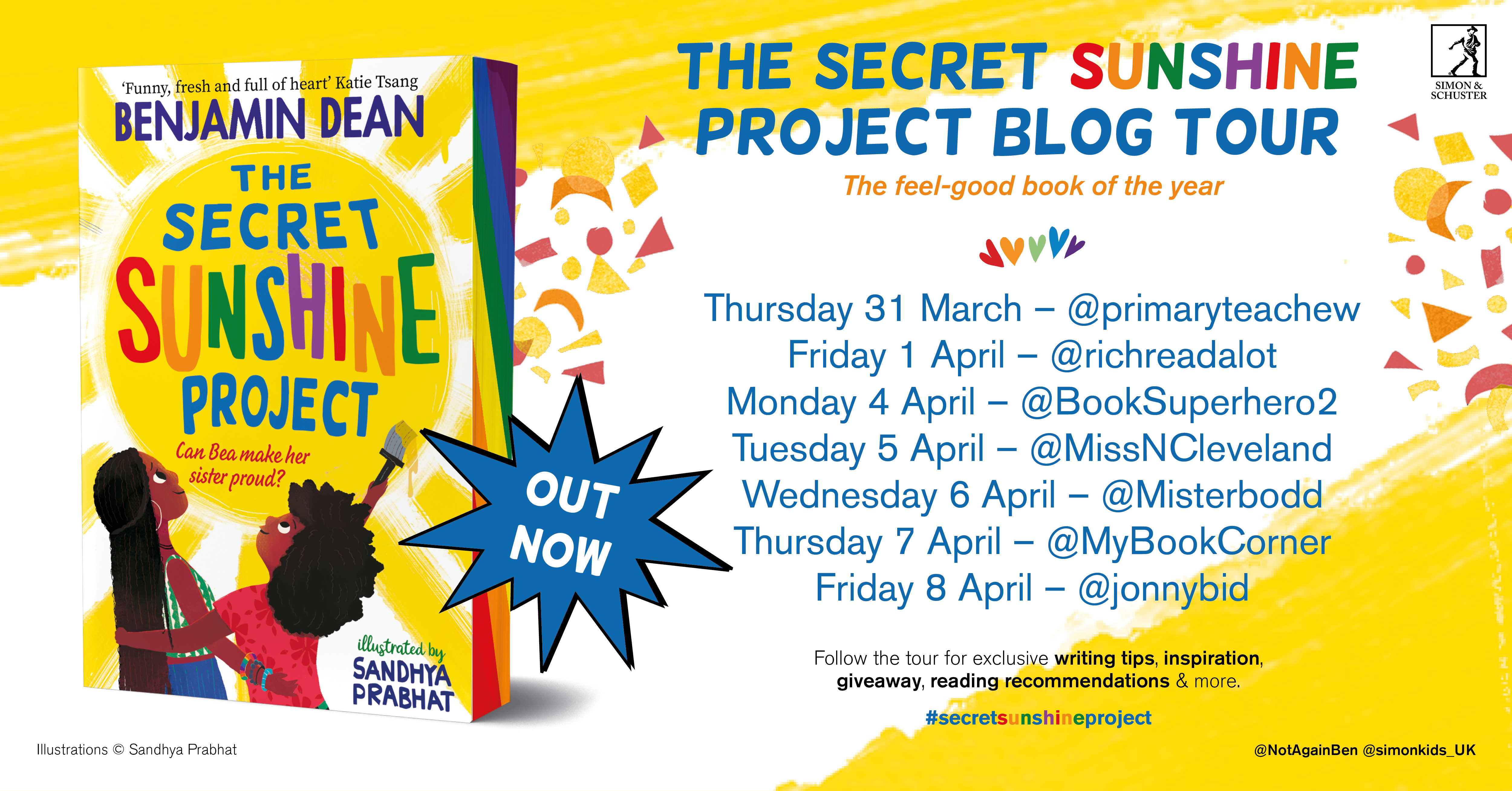
The Secret Sunshine Project by Benjamin Dean - blog tour

The Secret Sunshine Project by Benjamin Dean


Me, My Dad and the End of the Rainbow, Benjamin Dean's wonderful debut from 2021, is one of the most uplifting books I've read in recent years, and so I jumped at the chance to take part in the blog tour for his follow-up, The Secret Sunshine Project.

At its heart, The Secret Sunshine Project is a story about love in all its many forms. Bea and her older sister, Riley, move to a small country village, St Regent's Vale, to live with their grandmother following the death of their father. They each attempt to deal with their grief in different ways. Although Bea makes new friends, Riley increasingly shuts herself away from the world. She's missing her girlfriend and the freedom that life in a big city can bring, and is also heartbroken that she won't be able to attend London Pride. To support her sister, Bea and her friends decide to create their own Pride festival in St Regent's Vale. However, the self-appointed (but wildly unpopular) leader of the village, Rita Ruckus, has other ideas.

The story unfolds beautifully and builds towards a joyful conclusion. Benjamin Dean creates characters with real depth, all of whom have their own flaws and insecurities, and, as in real life, they rely on each other for support and strength in times of need. Throughout the book, an important message about having the courage to accept and love people for who they really are is regularly reinforced. Benjamin has very quickly become a writer whose work needs to have a home on the bookshelves in every primary classroom and I'm looking forward to seeing where he heads next with his writing. I honestly can't recommend The Secret Sunshine Project highly enough. It's available to buy now in all good independent children's bookshops. Look here to find where your local ones are.

Below, Benjamin has recommended some of his favourite books which have LGBTQ+ representation.


Benjamin Dean’s Recommendations for Books with LGBTQ+ Representation

As someone who knew they were gay from a pretty young age, I often felt lonely or othered simply because I couldn’t find myself anywhere else. Certainly not in my favourite books. Thankfully, LGBTQ+ representation is getting better and better as time goes on and it’s helping to show children a wealth of diversity within the pages of fantastic stories, opening the door for empathy, kindness and compassion. From mermaids and firefoxes to new worlds that can found inside a suitcase, here are some of my favourite stories that include LGBTQ+ representation.

Picture Books:

Nen and the Lonely Fisherman by Ian Eagleton & James Mayhew


The Pirate Mums by Jodie Lancet-Grant

Middle Grade:

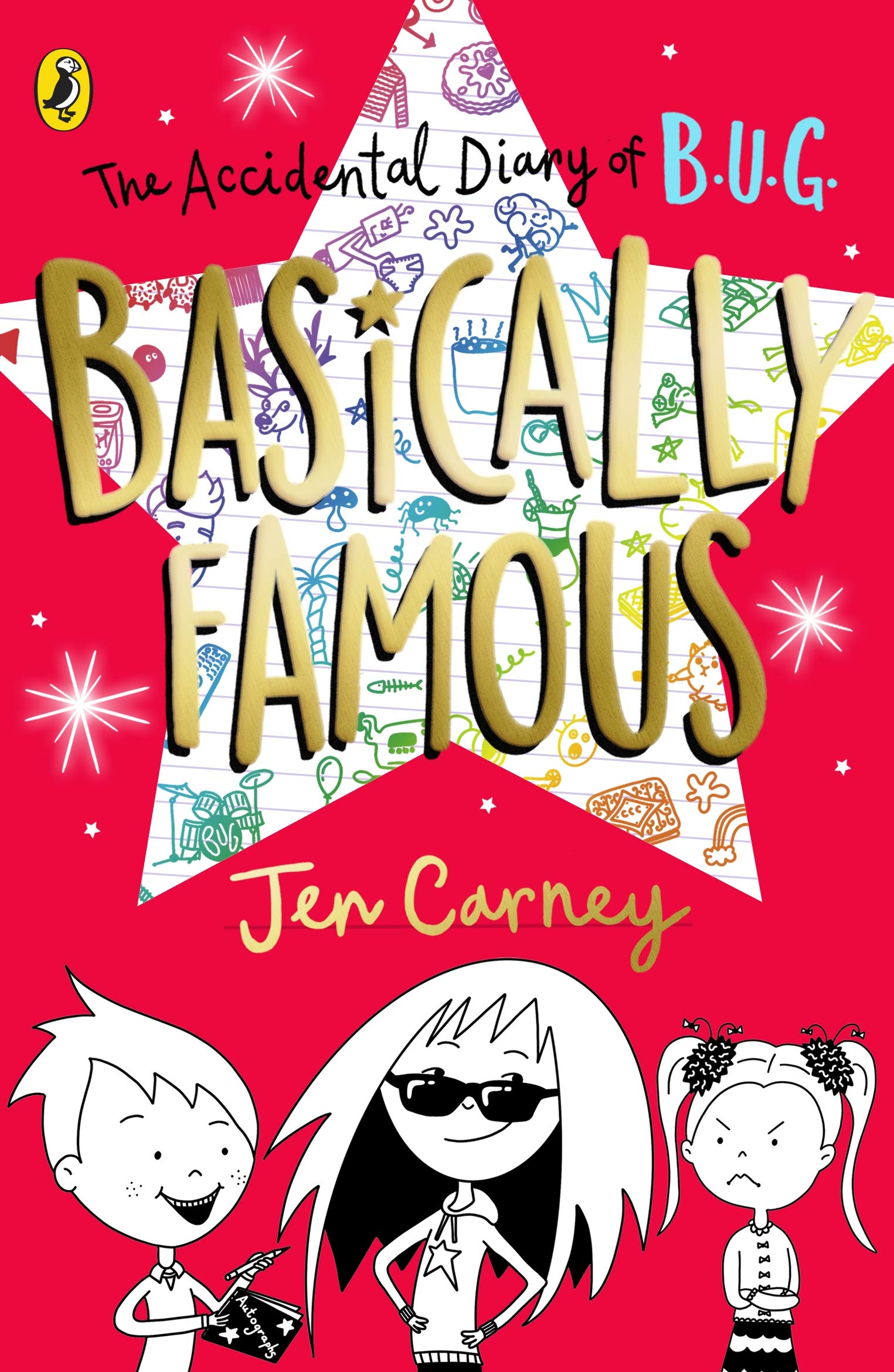
The Accidental Diary of B.U.G. series by Jen Carney


The Last Firefox by Lee Newbery

The Strangeworlds Travel Agency series by L.D. Lapinski

Proud of Me by Sarah Hagger-Holt

Me, My Dad and the End of the Rainbow by, uh, me

Wednesday, 15 December 2021

The World Book by Joe Fullman and Rose Blake - blog tour

A couple of months ago, I was delighted to receive a copy of The World Book by Joe Fullman (author) and Rose Blake (illustrator). It's exactly the kind of book I would have loved reading as a child, being full of fascinating facts and trivia about the 199 countries of the world. For example, did you know that Uzkebistan is double-landlocked? That means it's two countries away from the nearest coast. There's only one other double-landlocked country in the world, which is revealed at the bottom of the page (clue: it's in Europe).

Since taking The World Book into my classroom, it's barely been on the shelves during reading time and is a very popular choice with children who want to share a non-fiction text with one of their friends. It's a book that can be read from cover to cover, but it works equally as well when finding out about one specific country or continent or as a book to dip into and enjoy for a few minutes. As part of the book's blog tour, Rose Blake has written about five objects which inspire her as an illustrator.


Five objects which inspire me by Rose Blake
Speedo costume - I swim every day, and I couldn’t really go without this! The pool is a place where I can stretch my body and empty my mind, and sometimes if I’m lucky, ideas for drawings jump in.

Do!! You!!! Radio - The best morning soundtrack.

Persimmons - I like looking at them and eating them, and I hide them in my drawings too. Lots of my books have hidden persimmons in them…like a Where’s Wally? but for shiny orange fruit.

A book by Helen Garner - I’m very inspired by the way she looks at things. Light, love and friendship and the small things that make life interesting.

My Techo diary - So I know what to do with my day. I use it to write down interesting quotes and thoughts as well as my schedule. It opens flat on the table and is very satisfying to write in.


Thank you so much, Rose, I'll certainly give Do!! You!!! radio a listen. Please do follow the rest of the blog tour this week and make sure you track down a copy of The World Book. Thank you to Welbeck Publishing for inviting me to take part.

(The only other double-landlocked country in the world in Liechtenstein.)

Friday, 5 November 2021

The False Rose by Jakob Wegelius (translated by Peter Graves)

The Stone Roses released their debut album in 1989. When it first came out, I rushed to my local branch of Andy's Records to purchase a copy on cassette and, for at least three weeks, simply refused to play side two. In my opinion, there was absolutely no way that it could as mind-blowingly good as side one. It just couldn't. When I eventually did get round to listening to it, I very quickly realised that side two was equally as good, perhaps even better.

I should really have learned my lesson after that but, earlier this year, I made a very similar mistake. The Murderer's Ape by Jakob Wegelius is undoubtedly one of my top five children's books of the past few years and, a couple of months ago, I was fortunate enough to be send an advance copy of its sequel, The False Rose. It waited patiently on my pile of unread books for weeks as I was genuinely concerned that it wouldn't be a worthy follow-up. However, again, I couldn't have been more wrong. It's another absolute masterpiece.

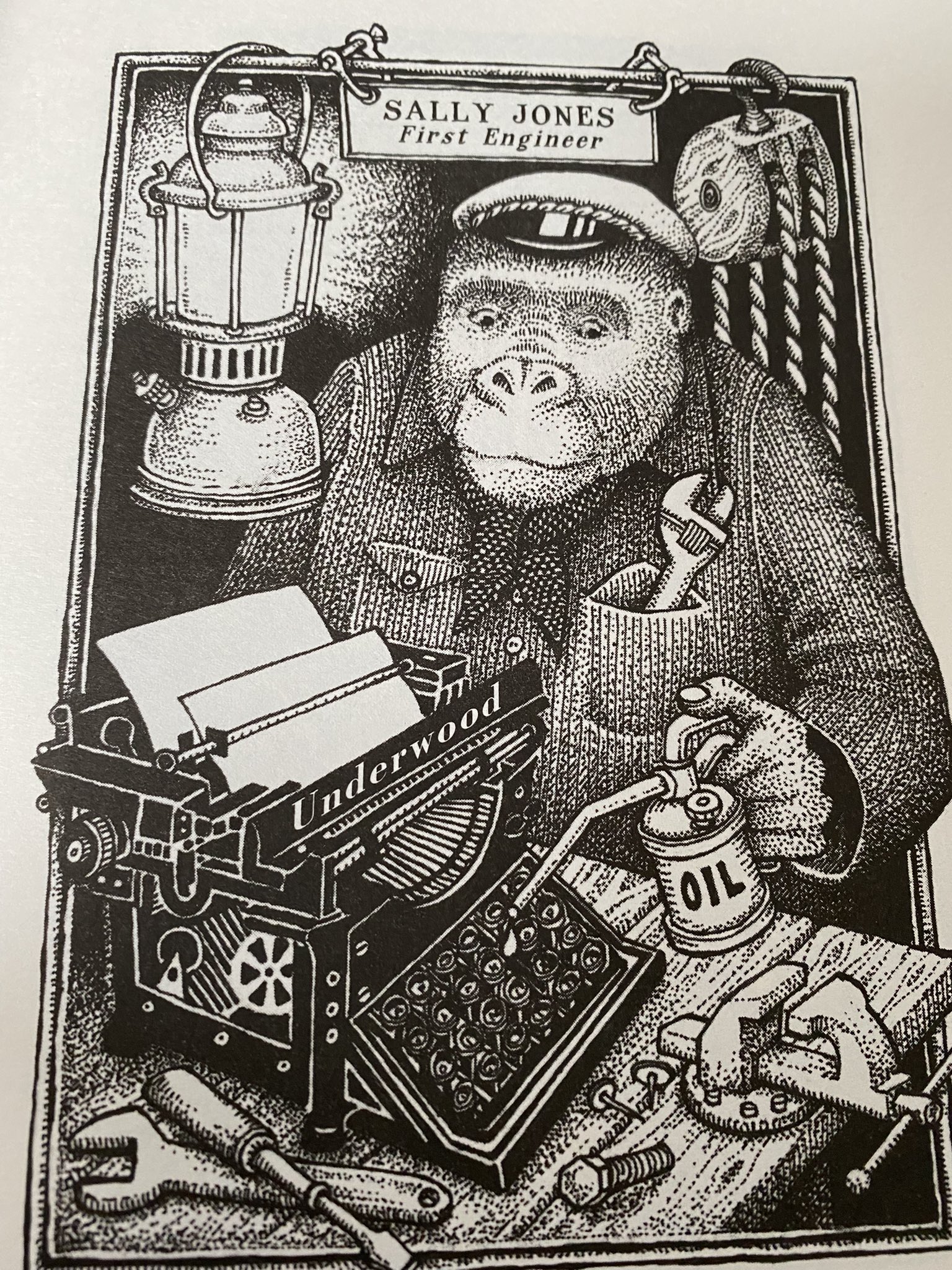
The story itself is complex and spans many different times and locations. Without going into detail, it stars Sally Jones, a seafaring gorilla, who travels to Glasgow in order to learn more about a mysterious necklace which has recently been discovered on her boat. In a similar fashion to The Murderer's Ape, the plot unravels at a perfect pace, with increasingly dastardly characters and villainous schemes introduced regularly throughout its pages.

Sally Jones

However, as with the first book, the real triumph is the characters and the relationships which exist between them. The cast is large but each character is so richly drawn and wonderfully constructed that there's absolutely no chance of the reader becoming confused. Subtle shifts in the dynamics between them are beautifully written, with real significance given to the different motivations of the villains. Sally's steadfast and unwavering loyalty to the Henry Koskela, Signor Fidardo and Ana Molina, the other returning characters from the first book, again shines through, as does her compassion towards Bernie, a hired thug with increasing reservations about the situation that he's found himself embroiled in. I can think of very few books where the characters feel as alive as this and I'm confident that you'll end up caring deeply about what happens to them all.

Although Jakob Wegelius is the genius behind The False Rose, being both author and illustrator, a special mention must go to Peter Graves, who's done an incredible job translating the book from its original Swedish.

The False Rose is truly special. Read it soon, read The Murderer's Ape too if you haven't already, and fall in love with the characters who inhabit the unique world of Sally Jones.

A huge thank you to Pushkin Press for inviting me to be part of this blog tour.

Tuesday, 28 September 2021

Violet's Tempest by Ian Eagleton and Clara Anganuzzi

Violet's Tempest is a beautiful picturebook collaboration between author Ian Eagleton and illustrator Clara Anganuzzi. It tells the story of Violet, a girl who needs to overcome her shyness and regain her confidence at school, and how the unconditional love and support of her family help her to do this.

Ian is rapidly developing into one of the most exciting children's authors around, subtly weaving important issues into his storylines, and Clara is clearly a talent to watch closely over the next few years. They've both been kind enough to share their favourite illustrations from the book, which is available now from independent children's bookshops. Thank you so much Ian and Clara for inviting me to be part of your blog tour, and I wish you every success with Violet's Tempest.

Clara Anganuzzi

My favourite spread in the book is the one where Nan and Violet are on the chair together with all their homey knick-knacks surrounding them. It reminds me of the comfort of family and home. I feel like it has a warm feeling to it and it really shows the support Nan gives to Violet, not only in that moment but throughout their time together (through the photos in the background and little trinkets).

Ian Eagleton

My favourite illustration is the final double page spread. Nan and Violet are holding hands and so are Uncle Sebastian and Uncle Tony. Violet’s Tempest was actually the first picture book I wrote, so having two men holding hands at the end of the story was a very important and emotional moment for me. Clara has filled the page with such warmth and magic. I also love that Violet is now leading her family home, she’s finally gained some confidence and is skipping ahead. I am very grateful to Holly Tonks and Alice Curry for their input in helping these final moments come to life and for their support when I said I’d like Uncle Tony and Uncle Sebastian to be holding hands. It feels like a magical end to the story, full of hope and happiness. 

Wednesday, 8 September 2021

Peanut Jones and the Illustrated City - Rob Biddulph


Rob Biddulph has illustrated some of my favourite books of the past few years, as well designing the front covers for several more. With the release of Peanut Jones and the Illustrated City, an energetic, original and highly-imaginative adventure, he's also now written one of my favourite books of the past few years.

Peanut Jones is finding it hard to adapt to all the changes that have taken place in her life. Her dad's gone missing, with no obvious clues as to his whereabouts, and she's struggling to fit in at her new school. Things take a turn for the bizarre when she finds an art pencil with mysterious powers. Suddenly, she discovers that whatever she draws on paper immediately becomes real and Peanut, along with Little Bit, her five-year-old genius of a sister, and Rockwell, her school Study Buddy (but most definitely not her friend!) gets transported to the magical world of Chroma. Also known as The City of Colour and Creativity, Chroma is made up of several different districts which include Warholia, Cubeside, Vincent Fields and Modernia. Although trying to avoid capture by the mysterious Mr White and returning home safely are Peanut's main priorities, finally finding out what actually happened to her missing father is also becoming an increasingly real possibility.

There's just so much that I love about this book. The illustrations, as you'd expect from Rob, are absolutely fantastic and the limited colour pallette, which is basically black, white and orange, works beautifully. However, my favourite thing of all is the wonderful collection of characters who appear throughout the story. Readers will be able to empathise with the central trio of Peanut, Little Bit and Rockwell, but the cameos from joyful creations such as Jonathan Higginbottom, the talking alligator with ambitions to become a nursery nurse, and Table Guy, the superhero with total command over items of furniture and who finishes every sentence with an exclamation mark, are absolutely hilarious. At almost 400 pages, it's certainly a hefty book but with short chapters and so much wonderful artwork, it's one that readers will absolutely fly through. Although the story is complete in itself, it's also sets everything up beautifully for the second part of the trilogy which is due sometime next year. I personally can't wait. 


Not only is Rob a wonderful illustrator and author, and the World Record holder for organising the biggest ever live draw-along, he's also an extremely considerate person who was kind enough to record short personal videos for each stop on the blog tour for his book. Thank you Rob, and thank you Macmillan Children's Books for inviting me to take part.

Friday, 23 July 2021

How To Be Brave - Daisy May Johnson

Pushkin Children's Books are one of the most original children’s publishers around and have released some stunningly good reads over the past few years. When I was invited to take part in the blog tour for How To Be Brave by Daisy May Johnson, I jumped at the opportunity.

Much of the story takes place in a boarding school, The School of the Good Sisters, which is run by a group of nuns with a very novel approach to teaching the curriculum. The opening few chapters explore the relationship between Elizabeth North, an orphan, and her childhood nemesis, Magda DeWitt. Without revealing too much of the plot, many of their problems are caused by the rescue of a small brown Amazonian duck.

The book then jumps forward a couple of decades, to a time when Elizabeth is single-handedly raising her young daughter, Calla. They live in considerable financial hardship, with Calla continually attempting to ground her mother, by now a world-renowned duck expert, in reality. When Elizabeth has a chance to travel to South America for a unique work opportunity, Calla is forced to attend The School of the Good Sisters. Changes in leadership at the school have turned it into a very different place, although Calla survives the hostile environment by forming close friendships with her two roommates, Edie and Hanna. After a few weeks, Calla loses contact with her mother and learns that she is missing somewhere in the Amazon. She then has to team up with her two best friends to try and work out exactly what is going on.

There is so much to love about this book. It's fun and energetic, being a wonderfully quirky updating of a traditional boarding school story, and it has a rich collection of characters. A personal favourite of mine is Gareth, a security guard who has an obsession with trying to improve the quality of his vol-au-vents. There are references to contemporary children’s literature (Robin Stevens and Eva Ibbotson both get a mention) which help give the book a modern feel. A chapter with strong similarities to the famous scene from the film Spartacus is genuinely funny, as well as delivering an important message about the importance of loyalty. The book is absolutely crammed full with amusing footnotes, which really help the reader develop a sense of empathy with the story's narrator.

Calla, Edie and Hanna

How To Be Brave touches on several important themes, including loneliness, friendship and poverty. The most powerful message for me is the way Calla learns that her mother, despite loving her daughter dearly, is not infallible, and often struggles to cope with the challenges of day-to-day life. It’s a universal message that we all ultimately learn, but it’s done with subtlety and with love.

I can see it being very popular with fans of the Murder Most Unladylike and Scarlet and Ivy series, and would be a perfect addition to a Year 5/6 class bookshelf. I thoroughly enjoyed it and look forward to reading more from Daisy May Johnson.

How To Be Brave was released on the 1st July and is available now from all good independent bookshops. Huge thanks to Pushkin for inviting me to take part in the blog tour.