Last week, the pupils at Moorlands Primary Academy were fortunate enough to receive an advance copy of
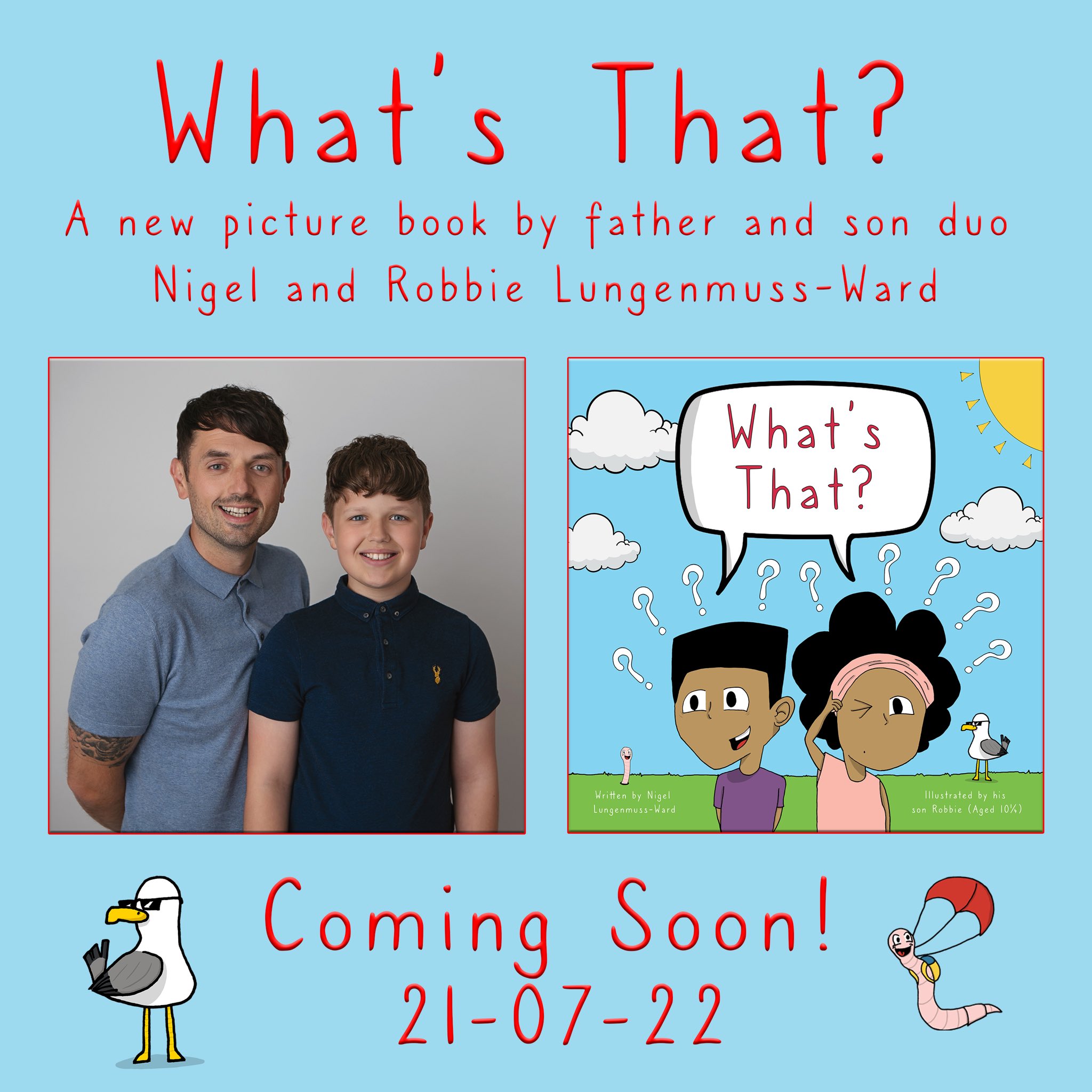
What's That?, the new book by Nigel Lungenmuss-Ward and his son, Robbie. I was also able to catch up with Nigel and ask him a few questions about the book.
What's That? was a real hit with the children. Below is a selection of the feedback from our Year One and Two pupils and staff.
"I love the seagull and worm." Harlee
"I enjoyed this story because she was using her imagination." Stanley
"It was amazing because I loved all the things that the children thought the cloth could be." Charlie
"This book is really creative and I like the drawings." Nellie
"I loved the colourful pictures in the book. It's really funny because there's a funny worm" Ella
"I loved it, loved it, loved it because the pictures were funny." Eloise
"I liked the giant in the story because it was the same one from Jack and the Beanstalk." Sam
"It's a great story because it's colourful and funny." Hollie
“My favourite part was when dad was reading Freddie's Impossible Dream!" Jessica
"I like that they use their imagination." Ollie
"I thought it was very funny and imaginative." Emmy
"The cloth can be anything they want it to be." Mary-Jane
"This book is very funny and I just loved the seagull." Hugo
"I loved the way that the story encouraged the children to use their imaginations to enter a fantasy land and explore endless possibilities." Miss Thurtle
Hi Nigel, I was a huge fan of your
debut book, Freddie's Impossible Dream. Your new book, What's That?, all about the
power of imagination, is out now. Where did the original idea come from?
Thanks Jon. I really appreciate your support and guidance
with the promo for the first book. The
inspiration for this book came from a game I invented, which I played my class
during transition week each year. After reading some research on developing
divergent thinking within the workplace I created The Imagination Game to
promote divergent thinking within my classroom. I would find a warm sunny spot on
the playground and present the class with a random object. Once, I used my
lunch box and, after a brief introduction on convergent and divergent thinking,
I asked them, “What’s this?” The first couple of children would usually stare
blankly at me until someone raised the bar. One child described my lunch box, whilst
giving a physical demonstration, as a potty. After this, the divergent thinking
would rapidly become more fantastical. I loved this activity as it offered me a
gateway into each child’s mind and, more importantly...it was also extremely
fun!
How do you suggest teachers encourage
children to use their imaginations at school?
I learned a very important lesson
whilst working with Robbie during the completion of our first book, which I
feel made me a better father and educator alike. It happened right at the very
start of Robbie drawing the pictures. I used to give him lots of details on how
I imagined the page would look. I would draw stick men and lay the page out for
him. I thought I was helping him, but I found that I was actually killing his
creativity and passion for the project. His drawings were not as good as the
ones he was completing when he was just doodling and doing it for fun. In fact,
he stopped wanting to even work on the book altogether. So, I tried a different
approach. I gave him minimal guidance and just wrote down the words for each
page and asked him to draw whatever he thought matched my narrative. I found
this is when his drawings really improved and his passion for the project
returned. The lesson I took into my classroom was to try and not over scaffold
things. Educators can sometimes be so engrossed in making sure that a child
achieves an outcome that we remove any form of creativity and independence for
the child. Of course, we need to support but from that day on I tried to pare
it back whenever I could.
It's lovely to see that you've
continued to work with your son as the illustrator. Did the text lead the
artwork or did the artwork lead the text? What was the creative process
behind the book?
As I mentioned in the previous
question, I write the story and then approach Robbie with it for him to draw.
With What’s That? though I asked him to start drawing the main characters before
I had finished my final draft. This is the part I think he enjoys the most. He
loves creating new characters and that is why I gave him free rein with
Wormington and Siago in this story, just like I did with Crabbie in Freddie’s
Impossible dream. These characters are all Robbie’s work. I have very little
input at all. In fact, I asked him for a character and of course he decided we
were having two. Whenever I visit schools with Freddie the children love the
Crabbie character the most and I really enjoy telling them that an 8-year-old
boy created it. I have a feeling that it will be the same again with Wormington
and Siago, which really is magical.
We were very lucky to have you visit
Moorlands at the start of the year. I believe it was one of your first school
visits and our children still mention you regularly. What do you think an
author visit can add to a child's school experience?
It was a pleasure to visit your school
and meet all of your wonderful readers! It is so great to hear that the children
remember me and that they enjoyed my visit. I have checked this; Moorlands was my
very first in school author visit. I was keen to come to your Moorlands as I
know the culture of reading for pleasure that exists in the school. From my
experience of visiting schools, the main benefit of having an author visit is
the impact it can have on a child’s view of reading and writing. I always try
to make my visits fun, engaging and inspirational. I particularly enjoy it when
I tell children I love reading and writing and they respond in kind. I feel
that having someone, who isn’t the children’s teacher, deliver this message is
vital to changing some children’s outlook upon the subjects. I have had several
instances where teachers have got in touch to explain how students have changed
post visit and they have become much more open to reading books or even a
bigger variety of books. If I can play a small part in changing even one
child’s life for the better then I will be a very happy man indeed.
What's next for you and Robbie?
We keep creating. My vision is to release a book every year,
which will serve as a timeline of Robbie’s drawing development. I believe that
the illustrations for What’s That? are a vast improvement on the illustrations
in Freddie’s Impossible Dream. I write because I enjoy it, but really, I write
because I want to showcase Robbie’s talent and give him the best possible
platform to achieve whatever he wants in life. As an educator, I feel that the
journey Robbie and I are on has the potential to inspire others to go and chase
their dreams and to achieve whatever they want too. I have several other ideas
and first drafts that are waiting to be published. I am also really looking
forward to working for the National Literacy Trust over the summer. I will be
leading six writing workshops for children with the aim of creating three stories
based on inventions from our hometown of Lowestoft, which will be showcased later
in the year. I am so excited about what the future holds, and I cannot wait to
hear what people think of What’s That?
Fantastic Nigel, thank you for your time. Good luck with the book launch!